Wiggins Excited To Help Sherwood Excel
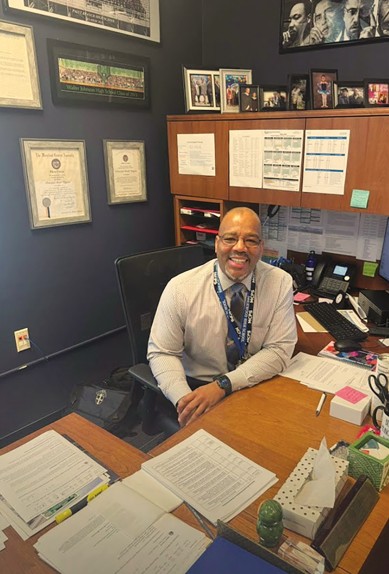
by Maya Dorsam ‘27 and Andrew Fenner ‘27
 In May of last year, MCPS named Micah Wiggins, a Baltimore County principal at the time, as Sherwood’s new principal. Wiggins worked in MCPS for 19 years, first as a teacher at Walter Johnson, then as an assistant principal in various schools in the county. After settling into his new school, The Warrior interviewed Wiggins about his experiences and plans for Sherwood.
You recently changed Sherwood’s core principles from the pillars to the ‘Warrior’s Code’. What was the purpose/goal of this change? What overall environment are you striving to create at our school?
I’m trying to do a better job of communicating with our students our expectations, because that’s really what they are. These are our core values. All warriors (historically ex. Samurai or Medieval) have some sort of code they followed. I felt that would more align with what we were as warriors, making sure when we talk about civility, when we talk about accountability, we talk about rigor, we talk about engagement that you all know what that means. So again, nothing new.
What I liked about the Warriors’ code is that kids created it. Another thing was that, when we talked about what Sherwood is known for, a lot of times people said athletics. Sometimes just being a strong student academically wasn’t celebrated consistently. I wanted to make sure that we were celebrating all students, the kids who may not be athletes, who may not have artistic expression or abilities, but are great kids. That’s very important to me as a principle that every student is seen, every student is known, every student is valued.
Improving schools’ ratings on the MD School Report Card is an MCPS goal, but could you explain what you see as data points for Sherwood to improve?
First of all, I want everyone to know, you’re more than a number. But, this is the system by which the state of Maryland ranks schools. Most of the schools that our school is compared with are either 4 or 5’s currently. When I looked at the data, I said, “There’s no reason that Sherwood is not a 5 star school.” But, a lot of students and staff don’t even know how the points are calculated. So, I wanted to make sure that over the summer, I met with the ILT, which is the Instructional Leadership Team of our school, and shared with them what the Maryland Report Court was and how the ratings were calculated.
We are already doing a great job. Our graduation rate, which is one of the areas that is ranked for high schools, is at over 95 percent, one of the highest graduation rates in Montgomery County. Areas where we can definitely continue to grow are with our English Language Learners. Another area we want to look at is what we call student growth, versus student proficiency. The Maryland Report card also looks at equity. So it looks at student groups. And so how are our African-American students doing? How are our Hispanic students doing? How are our economically disadvantaged students doing? How are our students with disabilities? How are English language learners doing? When our data is reviewed schoolwide, we are doing very well, but when you disaggregate the data, that is where you see the gaps, and my goal is make sure that ALL students are having a meaningful education experience here at Sherwood. Remember, “ONE SHERWOOD: A community of Rigor, Civility, and Belonging where ALL Warriors Thrive.”
Sherwood has had problems both with students not coming to school and with students being at school but not going to all their classes. How do you plan on combatting absenteeism?
Chronic absenteeism is an area that the average student doesn’t understand. If you miss more than 10 percent of school, or 18 days, you’re chronically absent. And the state of Maryland does not distinguish between excused or unexcused. The first thing is that we want to make sure kids want to come to school. I always tell this story of when I was a teacher, I had a student. His name was Robbie. I’ll never forget him. I was in North Carolina. I was teaching right outside Raleigh. So there were a lot of farms. “Mr. Wiggins,” he said. “I don’t need this thing y’all call school. My granddaddy was a hog farmer. My daddy was a hog farmer, and guess what? I’m gonna be a hog farmer. So I don’t need this, but I’m coming to school because I like your class.”
Another non-negotiable that I have is that all students have to have a trusted adult. Every student needs an advocate. You have to have someone that you feel connected with, and there are certain kids, unfortunately, who come to school and don’t have that connection. We have to work on that. Second, is that we have to be intentional about our school’s attendance interventions. We have students that we recognize are not coming to school. We have to identify what those reasons are, and what supports we have to do all that we can. That sense of belonging is important.
Bathrooms were frequently locked or boarded up last year and year before that. How do you plan on keeping bathrooms open despite possible misuse or damage?
We haven’t closed any bathrooms so far this year, and it’s not that we want to close them. We need you all to take care of the school, have some value and some pride in the school. We have 4 or 5 administrators. And we have 5 security guards. But it’s 1,600 of you all. This school has a lot of bathrooms, and we can’t always monitor them effectively. The feedback that I’ve had so far is that things are better than they were. Hallways are better, bathrooms are better. That’s where the students have to set a better example for their peers. We have a way of doing things, it’s called the Warriors’ CARE Code.
Before coming to Sherwood, you had been a teacher and assistant principal in MCPS and a middle school principal in Baltimore County. What are you taking from those experiences into your role as Sherwood’s principal?
I’ve always known since the 6th grade I was going to be a teacher. I had a teacher whose name was Ms. Wise, and she was wise. She changed my life. For me growing up in poverty, education was a way out of poverty. I just realized my why– I was not going to be a statistic. I was determined as a young African-American male not to be a statistic. It was not easy, I was the first person in my family to go to college and get a bachelor’s degree. It was very challenging taking high level courses, because my family did not have resources. I can remember my dad saying, if you were smart enough to get into class, you’re smart enough to stay in the class, figure it out. There was no money for tutoring or anything like that. So that’s what I had to do.
Education is very important to me. I’m very passionate about it, and I want to make sure every kid has an opportunity and access. As your principal, I am responsible for all your “tions,”: education, matriculation, protection, correction, and graduation. I take that job very seriously. As the principal, I cannot do my job without my assistant principals. So it is important that I collaborate with them to support our school, students, and staff.
I enjoy working with a class and moving kids through, you are introduced to them in the 9th grade, and you see them in the 10th grade. You see them in 11th grade. And finally you see the graduates as they walk across the stage. That day, you see the work that has been put in the transformation of young people. And then when you see them out in the community. As the principal, I get to see the whole picture.
Having been a middle school principal seeing the 6th, 7th, and the 8th graders, and now moving to high school, I see the whole secondary experience. I remember as a middle school principal what we were attempting to do. We want to make sure that we close gaps and that we provide opportunities and pathways so that when students leave school that they have options. So those are some of the experiences and lessons that I have learned as a teacher, that I am taking into this role as the principal of Sherwood High School.