Early Decision: Good for Colleges, Bad for Students
by Yasmin Sheikh ‘27
As juniors get closer and closer to college application season, the Early Decision option becomes a more familiar term to students. Applying Early Decision is a binding commitment, that if admitted to the college, the student must attend there. Students can pick only one school to be their Early Decision school, so this choice should not be taken lightly. Moreover, students should be aware that the Early Decision system advantages colleges and affluent applicants and disadvantages low and middle income applicants.Some well known private schools that offer Early Decision are Northeastern, Brown, University of Pennsylvania, Duke, and University of Chicago. Local institutions that offer Early Decision are American University, George Washington University, and Johns Hopkins University. Early Decision is rarely offered at public universities, but some include University of Virginia and University of Michigan. Yale and Princeton offer a non-binding early application called Single-Choice Early Action in which applicants are not allowed to apply to any early admission program at any other college in the United States.
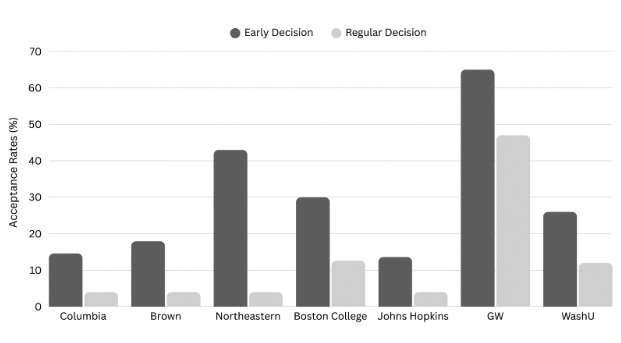
Admission statistics reveal that at many Early Decision schools, chances of admission are heavily increased if a student applies via an Early Decision application. For example, chances of admission at Northeastern were 11 times higher for Early Decision applicants than Regular decision for the Class of 2028; 43 percent of Early Decision applicants were admitted, compared to 3.83 percent of Regular Decision. Chances of acceptance at some schools, like at Northeastern, increase significantly when an applicant applies Early Decision, making this an extremely enticing option for students applying to competitive schools.
When a student applies Early Decision, they have to make a commitment before the college has provided a financial aid package. The rule is that if admitted, the student must attend the school, except when the cost is too much for their family. However, the college itself is the one that decides whether their financial aid package is sufficient. Both factors strictly limit the application pool for Early Decision to families who can afford the cost of attending the college without financial assistance. At Northeastern and George Washington University, cost of attendance including room and board is around 95 thousand dollars a year. When colleges admit applicants through Early Decision, they can ensure a significant portion of students are paying full tuition. While it may boost revenue for the college, low and middle income families are severely disadvantaged by the Early Decision system as a result.
Students applying Early Decision are also forced to make a life altering decision at the young ages of 17 or 18. If students commit themselves to one college, they could potentially miss out on other college opportunities—even more prestigious options. Early Decision makes it impossible for students to weigh their options between schools because students must withdraw applications to all other colleges if they are accepted Early Decision. If a student receives multiple Regular Decision acceptances, they can use different financial aid offers as leverage to negotiate better financial aid or merit based aid options. With Early Decision, students have limited opportunities to advocate for better aid.
As application season approaches, students should be cognizant of this enticing but risky option when applying to colleges. Students should weigh the pros and cons of Early Decision and realize that it may not be as beneficial as the numbers make it seem.